The case in one frame
In the early hours of March 18, 1990, two men posing as police officers gained entry to Boston’s Isabella Stewart Gardner Museum. They restrained the night guards and spent about eighty-one minutes inside. Thirteen objects were removed, including works associated with Vermeer, Rembrandt, Degas and Manet, along with a Chinese bronze beaker and an eagle finial. The FBI describes it as the largest property crime in United States history. Those details are established. The identities of the thieves, the chain of custody after the theft and the present location of the works remain unresolved.
Sources: Federal Bureau of Investigation · Federal Bureau of Investigation

How the thieves entered
The police disguise is central because it explains access without turning the event into a flawless cinematic caper. The men used the museum’s night bell and claimed they were responding to a disturbance. Once admitted, they overpowered the guards in the basement. The sequence is supported by the investigative account, but it does not prove that every later suspect knew the museum or that an organized-crime theory is correct. A reconstruction should distinguish actions recorded that night from motives assigned years later. The official seeking-information material is written to recover objects, not to endorse a favorite culprit.
Sources: Federal Bureau of Investigation · Federal Bureau of Investigation
What disappeared
The FBI’s wanted page is the most useful visual inventory because it identifies each missing object and provides images intended for recognition. The group is not simply ‘thirteen paintings’: it includes sketches, decorative objects and paintings of very different size and cultural origin. That variety matters to recovery because an object can be separated from the others, reframed, stored or sold through a different channel. The bureau says its investigation determined that the works were separated after the robbery and could be located anywhere. A claimed sighting of one object therefore cannot establish the fate of the full group.
Sources: Federal Bureau of Investigation · Federal Bureau of Investigation
Why the empty frames matter
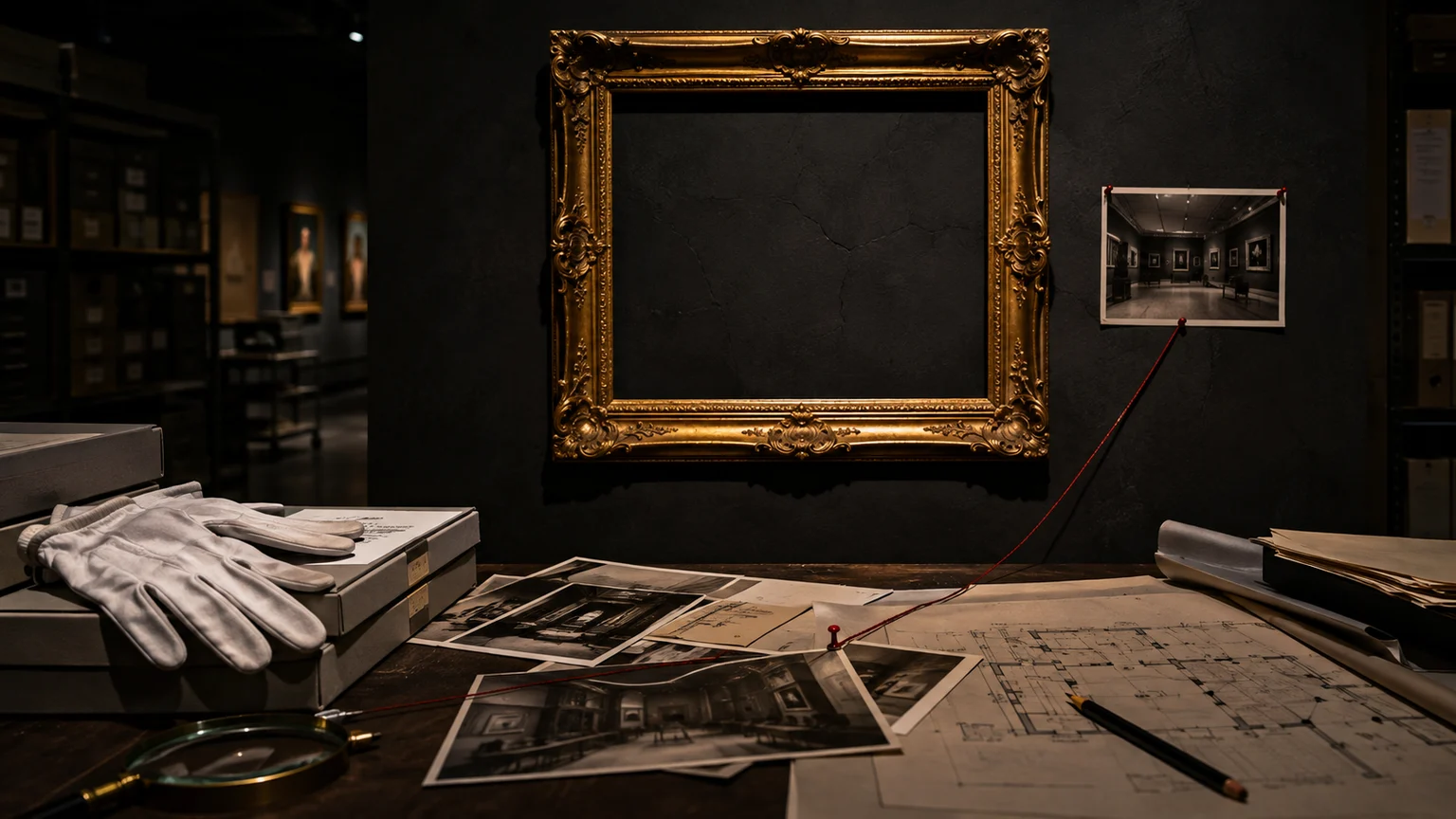
The Gardner Museum’s empty frames have become part of the public memory of the crime. They preserve the intended placement in a museum whose founder arranged rooms as a complete work. The frames are evidence of absence, not evidence of where the objects went. That distinction sounds obvious, yet visual storytelling often uses them as a backdrop for a suspect theory. The more responsible use is curatorial: compare the FBI inventory with the spaces from which works were cut or removed, understand why their position mattered, and retain the possibility of return without fabricating a new ending.
Sources: Federal Bureau of Investigation · Federal Bureau of Investigation
What the investigation asks from the public
The case remains an active recovery matter. The FBI invites tips and maintains the works in the National Stolen Art File; the museum separately offers a reward under its own terms. The official page makes clear that the FBI does not administer that reward. Readers with information should use the listed law-enforcement or museum channels, not public accusation threads. Publishing an unverified private name can damage an innocent person and does not move the evidence. The productive questions concern an object’s provenance, location, handling history and verifiable connection to the stolen inventory.
Sources: Federal Bureau of Investigation · Federal Bureau of Investigation
How to view the visual record
Treat the FBI image list as a recognition tool and the case history as the narrative spine. Open individual object images from the wanted page, record titles and object type exactly, and avoid downloading uncredited reproductions from repost sites. For a visual story, pair each object with the official status: stolen, still sought, and not publicly recovered. The page’s emotional power comes from what is missing, so it does not need invented surveillance frames or AI reconstructions presented as history. The empty space is already an honest visual language for an unsolved theft.
New claims appear regularly, often tied to alleged confessions, organized-crime figures or private searches. A defensible update requires a named source, a chain connecting that source to an object, and confirmation from the museum or investigators when available. The absence of a public recovery announcement is not proof that authorities possess no private lead; it means the public record remains open. ViceHeaven labels the overall outcome unconfirmed because the works have not been publicly returned and no final account identifies the thieves.
Sources: Federal Bureau of Investigation · Federal Bureau of Investigation
Questions, answered
What is verified in this Gardner Museum heist guide?
Statements labeled as established are tied to the listed primary records. Identity claims, interpretations or outcomes absent from those records remain explicitly unresolved.