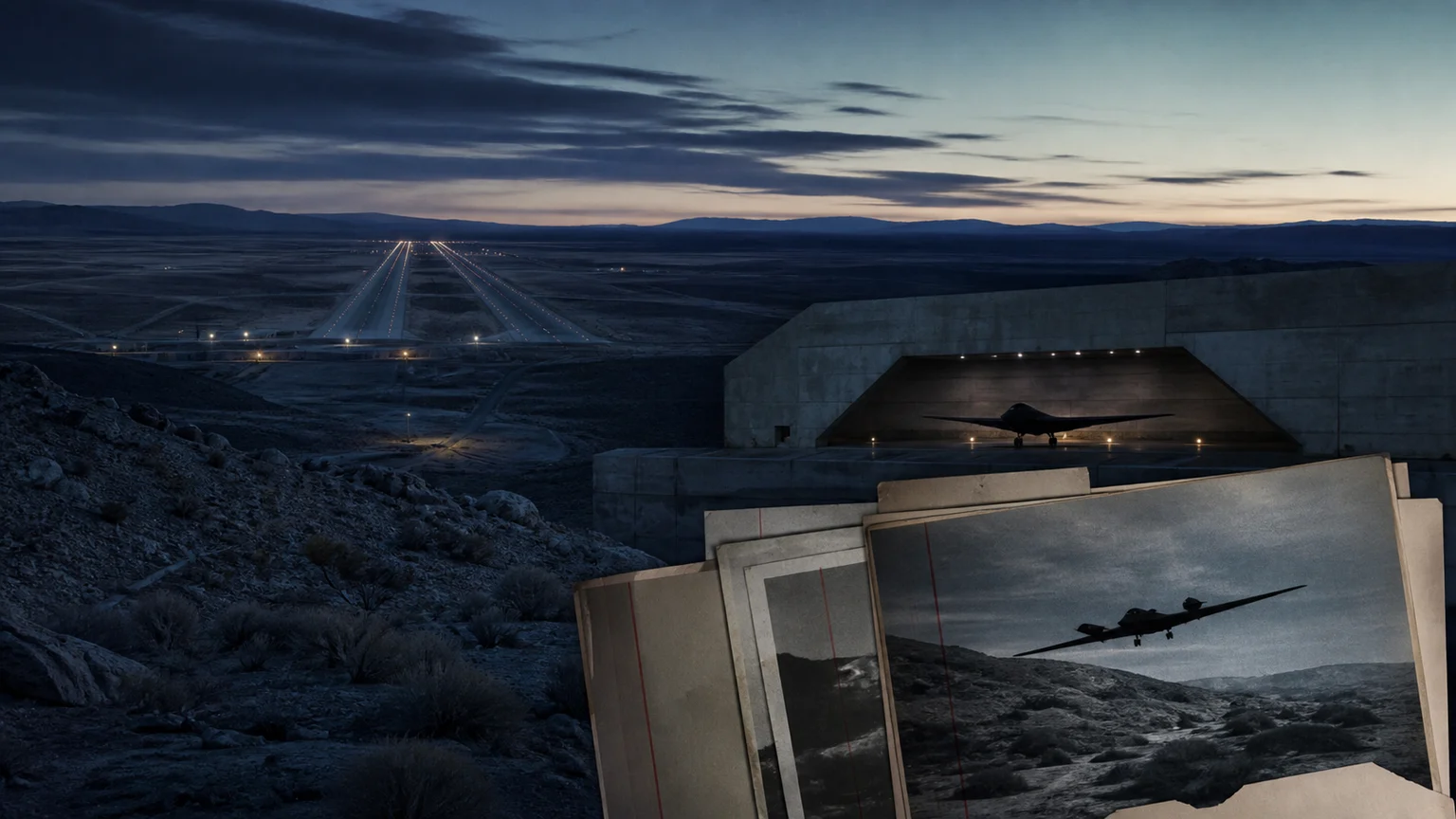
Verdict: a secret aircraft site, not proof of aliens
The CIA’s declassified history identifies Groom Lake in Nevada as the remote site used to test the U-2 reconnaissance aircraft and later advanced programs. Area 51 and Watertown were names used for the location, while Lockheed engineer Kelly Johnson promoted the friendlier Paradise Ranch or the Ranch. That history verifies secrecy, restricted access and extraordinary aviation work. It does not verify extraterrestrial bodies, recovered spacecraft or a universal explanation for every sighting. A fact check should preserve the documented secret rather than replacing it with a less supported one.
Sources: Central Intelligence Agency · Central Intelligence Agency · Central Intelligence Agency
Why Groom Lake was selected
Program officials needed an isolated area where an unusual high-altitude aircraft could be assembled, tested and flown away from ordinary traffic and observers. A dry lakebed near the Nevada proving grounds offered space, existing military control and natural landing terrain. The location was added to the relevant government holdings with presidential approval. Personnel and components arrived through controlled air transport, reinforcing the sense of a place missing from normal maps. Those logistics explain why rumors could grow even among people who correctly perceived unusual activity.
Sources: Central Intelligence Agency · Central Intelligence Agency · Central Intelligence Agency
The accidental first flight
On August 1, 1955, Lockheed test pilot Tony LeVier accelerated the prototype U-2 during a high-speed taxi test and unexpectedly became airborne. He returned to the lakebed after a difficult height judgment and a bounced first landing attempt. The CIA treats this as the first unofficial flight; official flights followed on August 4 and August 8. This compact episode shows why primary histories matter: it gives names, dates, aircraft and sequence to a story that might otherwise circulate as an unidentified craft seen above a forbidden desert.
Sources: Central Intelligence Agency · Central Intelligence Agency · Central Intelligence Agency
Advanced aircraft and strange sightings
The U-2 flew higher than conventional aircraft of its era, and later programs introduced unfamiliar silhouettes and performance. Civilian observers without program context could report lights or motion they could not identify. That makes secret aviation a plausible source for some sightings, not a blanket solution to every report in the American West. The evidence standard remains case-specific. A declassified program can explain why officials withheld information and why witnesses saw something unusual while leaving the nature of an unrelated sighting unresolved.
Sources: Central Intelligence Agency · Central Intelligence Agency · Central Intelligence Agency
What declassification can and cannot do
A partially redacted official history reveals program purpose, organizational decisions and many operational details while leaving other material protected. A redaction is evidence that information was withheld under a review process; it is not a readable statement whose missing words can be supplied by imagination. Likewise, the later official use of the Area 51 name confirms the site’s place in U-2 history but does not certify claims about activities beyond the released record. Declassification narrows uncertainty. It rarely eliminates it.
Sources: Central Intelligence Agency · Central Intelligence Agency · Central Intelligence Agency
How to explore the archive
Begin with the CIA’s illustrated Area 51 story, then use the full U-2 monograph for chronology and citations. Follow named aircraft, dates and people into the Reading Room. Keep contemporary memoranda separate from later institutional histories, and note when a photograph comes from a participant collection rather than an agency camera. The most compelling visual narrative is already present: desert selection, secret transport, prototype assembly and an aircraft that climbed into a new surveillance era. No fabricated alien image is necessary to make the archive feel strange.
Sources: Central Intelligence Agency · Central Intelligence Agency · Central Intelligence Agency
Evidence notes and limits
Official agency history is uniquely valuable here because it confirms activities once protected by secrecy, yet it should still be read critically. A later CIA feature may simplify a technical chronology or select anecdotes for a general audience; the longer monograph supplies citations and institutional context. Conversely, a declassified memorandum records what its author knew or reported at the time, not an omniscient account of every program at Groom Lake. ViceHeaven labels those source types separately and will not use an AI reconstruction as documentary imagery. The remaining unknowns stay unknown, while the verified aircraft story receives enough space to explain why the mythology became so resilient.
Sources: Central Intelligence Agency · Central Intelligence Agency · Central Intelligence Agency
Questions, answered
What is verified in this Area 51 declassified history guide?
Verified statements are tied to the listed primary or official records; disputed interpretations and unresolved identities remain labeled as such.